



Mary Stella Abubakar Muya does not hesitate when she talks about where she started. Before she came to the Ruvu JKT Community Learning Centre (CLC) in Mtambani ward, she was a single mother of two, frying cassava and mandazi on the street to get through the day. Her co-parent had been gone a long time. The business kept food on the table, but only just. There was no capital to grow it, no path forward she could see.
That changed when her ten-cell leader mentioned that an adult education and skills centre was starting near Ruvu JKT Primary School. Mary Stella lived close enough to hear the announcement clearly. She followed up, registered, and became one of the first learners at what is now known locally as the MUKEJA centre.
"The four years I spent learning here are the same four years my son used to finish his diploma and start his degree. I am the one paying for his education."
That was not an easy decision. She was a mother with a household to run. Classes ran at 11 AM and 3 PM — both times that cut across cooking, childcare, and the street business she depended on. "Your mind isn't fully at school," she admits. "Your mind is at home, thinking about what the children will eat." She kept going anyway.
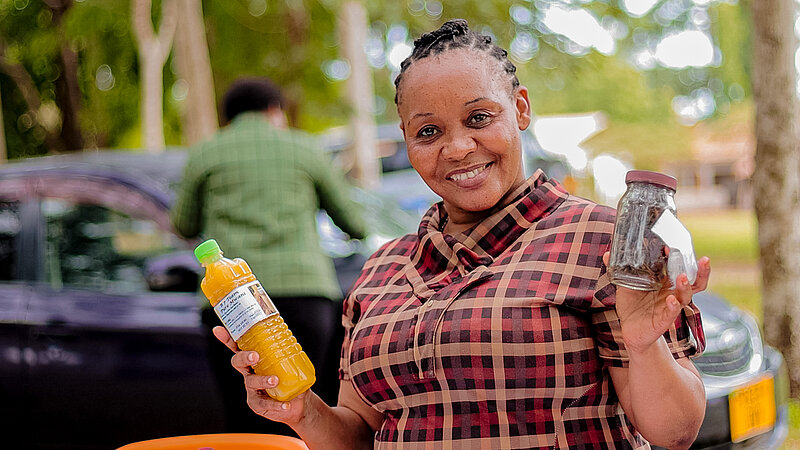
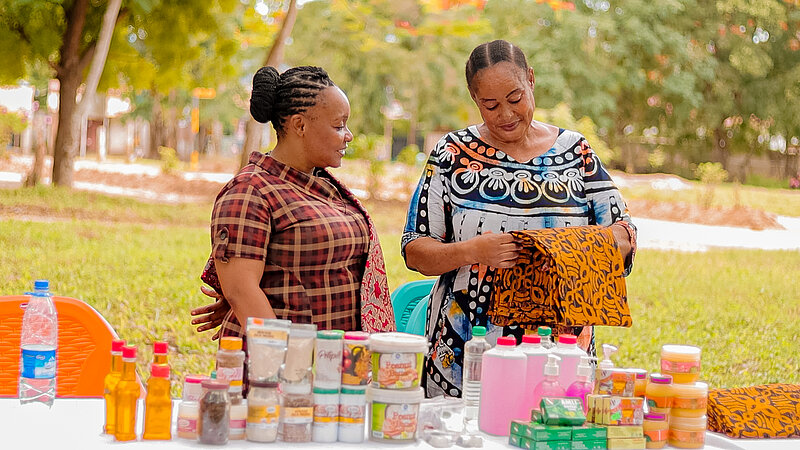
Over four years at the centre, Mary Stella did not just learn one or two things. She learned batik fabric printing, five types of wine-making: rosella, grape, pineapple, sugarcane, and starfruit, and how to produce a Vicks-style medicinal ointment by hand over a charcoal stove, a product she says treats up to six skin conditions as well as respiratory problems. She learned bar soap production. She learned the business side: costing, packaging, finding customers.
She chose to specialise in batik and wine because, she explains simply, those were the ones other people found too difficult. "I do them in bulk. I make the things that others give up on."
"My other child finished Form Four last year. I am now preparing to send him to Form Five and Six because he passed well. All of this is because of MUKEJA."
The income from her products changed the shape of her life. Her son, who was in primary school when his father left, finished secondary school, completed a diploma, and is now pursuing his first degree, with Mary Stella covering the fees. Her younger child finished Form Four with strong results and is heading to Form Five. She has also bought a plot of land.
Today, Mary Stella is already looking beyond her own household. She wants a small factory, one section for wine processing, another for batik. "If I get a factory, I will be an example to others," she says. "I will teach them and help them reach where I have reached."
Her advice, particularly for women, is direct: "Let us not give up. It doesn't matter what kind of difficult life we are going through. If a problem hits us, we won't just stare at it; we will look to the future. That problem will just be a bridge to cross. Just like me, I passed through it."
Mary Stella has been at the CLC for four years. She is still there — not as a student now, but as a presence, a proof that the centre works.