


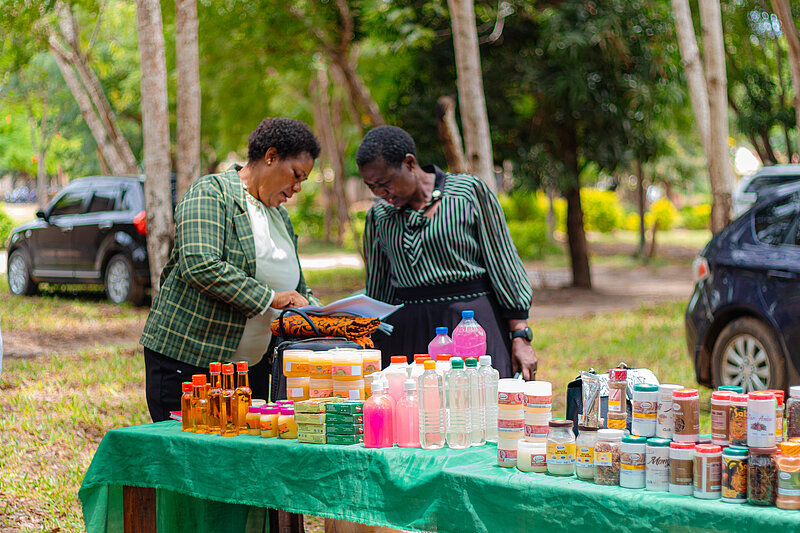
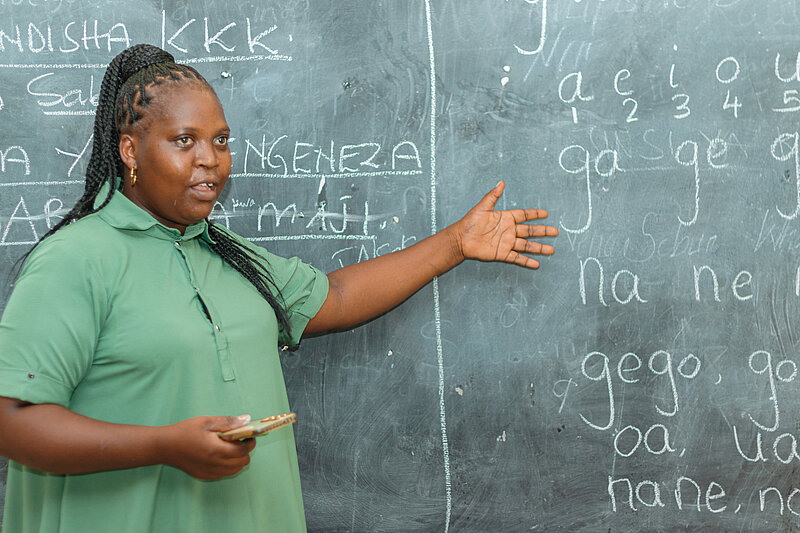
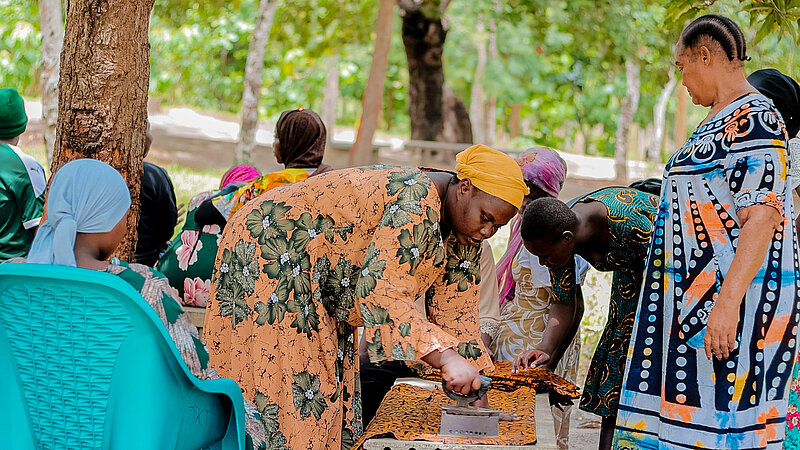
When people talk about the Ruvu JKT Community Learning Centre in Kibaha, they tend to discuss the fish ponds, the vibrant batik fabrics, the women who built businesses from scratch, and the men who finally secured their driving licences. They talk about the visible things. What is less often talked about, but what makes all of those stories possible, is the architecture underneath. The governance, the cross-departmental coordination, the financial modelling, and the way district budgets are passed. That part of the picture is less photogenic, but it is the true engine of the centre.
And at Ruvu JKT, it is working.
Rooted in community context analysis
The Ruvu JKT CLC did not begin with a building and a pre-packaged programme. It began with a question. Teacher Nasikiwa Mbwambo, the centre’s coordinator, describes how the team went out to the five sub-villages of Mtambani ward before anything was set up to conduct a rigorous community context analysis. “We discovered that the needs of many community members focused on areas of agriculture and livestock, which they are heavily involved in, especially fish farming,” she explains. “We are near the Ruvu River, and more than three-quarters of the residents here engage in fishing for their livelihoods. We saw this as our starting point.” That survey shaped everything that followed. The fish pond, the vegetable garden, the vocational workshops – none of these initiatives were modelled on a template. They were built to answer specific local demands. This alignment is the core of DVV International’s Adult Learning and Education System Building Approach (ALESBA), ensuring the centre acts as a true hub for lifelong learning rather than a rigid, traditional school.
Governance that meets the bottom line
The CLC is run by a management committee that meets quarterly. Committee member John Pili describes his role simply: He is part of the local government leadership in the area, and through that position, he joined the committee to provide direct oversight. “As a committee, we meet to evaluate our plans and see if we are meeting our goals,” he says. “We discuss how to ensure the survival and sustainability of our centre.” What John Pili is most clear about is the financial resilience the centre has developed. “These projects generate their own income,” he notes. Revenue from the fish harvest funds seed purchases for the greenhouse. Tailoring and batik products generate cash flow. The centre has deliberately built multiple, intersecting income streams, reducing dependency on any single source.
“We believe that even if the sponsors say ‘enough,’ these projects will continue to survive.” - John Pili
The district is a co-investor, not just a regulator
The relationship between the Ruvu JKT CLC and Kibaha District Council goes far beyond basic oversight. The council is an active co-investor. When it became clear that residents were highly interested in fish farming, the District Council helped finance and excavate the pond. When DVV International donated two sewing machines, the council immediately budgeted for two more to meet the surging demand. Mektilda Kahindi, the District Adult Education Officer, describes the integrated service delivery model the centre has achieved. The Agriculture Department sends extension officers to teach organic farming, the Fisheries Department provides pond management expertise, the Health Department brings nutritionists, and the Community Development Department connects learners to government loan funds. “We collaborate well with all departments and incoming organisations,” Kahindi says. “Together with the Community Development Department, we analyse data and set concrete plans.” Shukuru Lusanjara, the District Community Development Officer, explains that this partnership is structural. Tanzania’s planning process requires that district plans originate at the local level. “We involve this CLC extensively because they participate at that grassroots level,” he says. “Because if a plan doesn’t go through the grassroots, it is incomplete.”
A formal budget line
One of the most significant signals of sustainability from the Kibaha District Council is the decision to absorb adult learning and education into the formal district budget. “The Adult Education department is recognised in this year’s budget,” Kahindi notes. “Although it is still in the approval process, we budgeted for at least six million shillings.” While six million shillings is a starting point, it represents a massive systemic shift. The council no longer views the CLC as an external NGO project, but as a core public service that belongs in the budget alongside primary schools and health clinics. Shukuru Lusanjara makes this commitment explicit: “If the sponsors leave, we as a District Council are prepared to take over and sustain it through our own internal revenues. We believe as our revenues increase, we will continue to prioritise adult education.”
What replication looks like
Teacher Benadina Wilson Kahaabuka, District Education Officer for Kibaha, has watched the centre’s success ripple outward. Teachers and local government staff from Mlandizi have already started digging their own fish ponds in their home communities after visiting the centre. “Any Kibaha resident who visits this project leaves motivated to start their own,” she says. That ripple has now reached the national level. During the National Literacy Week celebrations, it was formally announced by the government that the guidelines and curricula piloted at centres like Ruvu JKT should begin implementation across all of Tanzania. Mektilda Kahindi’s advice to other districts looking to replicate this success is simple and practical: “Every District Council should set a plan. Start with two or three centres. Every school is an adult education centre. We have teachers, we have classrooms, and the community has needs. When we started, we had no budget, but eventually, we built the cooperation.”